How Christian Parents Can Disciple Kids in a Sexually Broken World
How do we raise children with wisdom, courage, compassion, and truth in a world that feels increasingly confusing and broken?
For many Christian parents, the conversations around sexuality, identity, gender, pornography, attraction, and God’s design can feel overwhelming. We want to protect our kids. We want to keep them safe. We want them to know Jesus, love what is good, and walk in truth.
But sometimes, if we are honest, our desire to protect our kids can quickly become fear-based parenting.
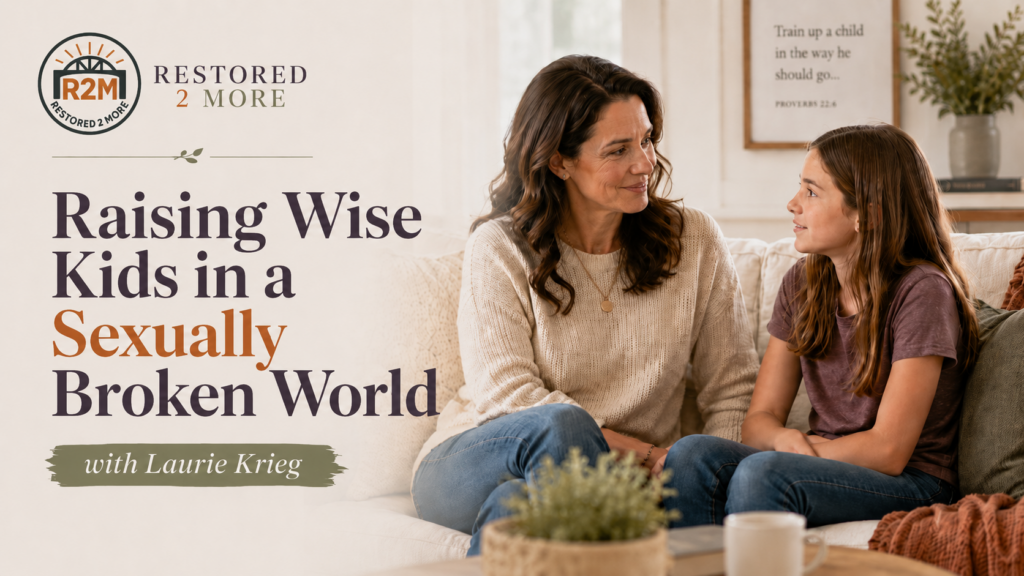
In this episode of the Restored 2 More Podcast, we sat down with Laurie Krieg, author of Raising Wise Kids in a Sexually Broken World, to talk about how Christian parents can move from fear to discipleship. Laurie brings a rare combination of conviction, compassion, wisdom, and honesty to this conversation. She shares from her own story, her years of ministry experience, and the practical ways she and her husband have learned to disciple their own children through hard and important conversations.
This episode is not about giving parents a perfect script.
It is about helping parents become a safe, steady, Christ-centered voice in their children’s lives.
We Cannot Disciple Well From Fear
One of the biggest themes in this conversation is fear.
As parents, fear makes sense. We look around at the culture, the internet, social media, the confusion around identity, the normalization of sexual brokenness, and the pain so many people are carrying — and we feel scared.
Fear says, “Protect them from everything.”
Fear says, “Avoid the conversation.”
Fear says, “If I don’t talk about it, maybe they won’t encounter it.”
Fear says, “If I expose them to the world at all, they will fall apart.”
But fear does not produce deep discipleship.
Laurie used the analogy of children being like young trees. Trees need good soil, nutrients, and care — but they also need the right amount of wind to develop strong roots. If a tree grows without any resistance, it may not become strong enough to stand.
Our kids need protection, but they also need preparation.
They need truth, but they also need compassion.
They need boundaries, but they also need conversations.
They need parents who are not panicking, avoiding, or reacting — but walking with Jesus and helping them interpret the world through the gospel.
The goal is not to throw our kids into a hurricane. The goal is also not to bubble wrap them from every difficult thing.
The goal is to disciple them.
Discipleship Is Not One Conversation
Many of us grew up with “the talk” as one awkward conversation that happened once, if it happened at all.
But gospel-centered discipleship is not one conversation. It is an ongoing way of life.
Laurie talked about how these conversations happen naturally and repeatedly in her home. Not because every conversation is formal, heavy, or planned, but because Jesus is part of everyday life. When we see the world through the lens of the gospel, we learn to help our kids do the same.
That means when our kids hear something confusing, see something they do not understand, or ask a hard question, we do not have to panic. We can pause, pray, and engage with wisdom.
Instead of saying, “We don’t talk about that,” we can say, “Let’s talk about that through what we know is true about God, people, brokenness, and love.”
Instead of responding with shame, we can respond with curiosity.
Instead of reacting in fear, we can respond with steadiness.
Instead of ignoring hard topics, we can help our kids build a framework rooted in Scripture and compassion.
Our kids are already learning about sexuality, identity, bodies, relationships, and brokenness from somewhere.
The question is: will we become the safest and wisest voice in their lives?
Truth and Compassion Are Not Enemies
One of the most powerful parts of this episode was Laurie’s ability to hold both conviction and compassion together.
Many Christians feel like they have to choose between truth and love. Either we hold to God’s design and become harsh, or we show compassion and feel like we are compromising.
But Jesus never asks us to choose between truth and love.
He is full of both.
Laurie reminded us that when we truly understand the gospel, we do not approach other people’s brokenness from a place of superiority. We approach it from humility.
We all need Jesus.
Some people’s brokenness is more visible. Some people’s struggles are more culturally debated. Some people’s pain is easier for Christians to label from a distance. But the ground is level at the foot of the cross.
When we understand our own need for grace, it changes the way we respond to others.
We can teach our kids that God has a good design for sexuality, bodies, marriage, and identity. We can also teach them that people who struggle, question, or live outside of that design are not enemies to mock, avoid, or fear.
They are people made in the image of God.
People to love.
People to pray for.
People to treat with dignity.
People who need Jesus, just like we do.
Our Kids Are Watching How We Respond to Brokenness
Even if our kids never personally wrestle with certain questions around sexuality or identity, they are still watching how we respond to people who do.
They are watching how we talk about people.
They are watching what makes us afraid.
They are watching whether our theology produces compassion or contempt.
They are watching whether we can stay grounded in truth without becoming cruel.
That matters deeply.
If our children hear us mock people, dismiss pain, or speak with disgust, they may learn that the church is not a safe place for honest struggle.
But if they hear us say, “God’s design is good, and people who are hurting need compassion,” they learn something different.
They learn that truth is not fragile.
They learn that compassion is not compromise.
They learn that Jesus moves toward broken people.
They learn that Christians can be both deeply rooted and deeply loving.
This does not mean we affirm everything.
It means we reflect Jesus in the way we engage.
Parents Need to Be Discipled Too
One of the most important takeaways from this conversation is that parents cannot give what they do not have.
Many Christian adults were never discipled well in the areas of sexuality, identity, attraction, pornography, shame, or God’s design for the body. Some grew up with silence. Some grew up with fear. Some grew up with shame-based teaching. Some grew up with confusion. Some were deeply harmed by sexual brokenness in their own story.
So when it comes time to disciple our own kids, we can feel unprepared.
That is why this work begins in us first.
We need to bring our own fear to the Lord.
We need to examine our own discomfort.
We need to study, learn, and grow.
We need to understand what we believe and why we believe it.
We need to ask Jesus to form compassion in us for people whose stories are different from ours.
We need to allow the gospel to reach our own places of shame and brokenness.
Prepared parents are not perfect parents.
Prepared parents are humble, teachable, prayerful, and willing to keep showing up.
Pray, Study, and Keep Showing Up
Laurie offered a simple but powerful framework: pray, study, and keep going.
Prayer matters because we need the Holy Spirit. These conversations are too important to be led by panic, pride, or fear. We need wisdom from God.
Study matters because good intentions are not enough. Parents need more than opinions. We need language, understanding, and a biblical framework that helps us talk about complex topics with clarity and care.
And we keep showing up because discipleship takes time.
There will be awkward moments.
There will be questions we do not know how to answer.
There will be conversations that feel uncomfortable.
There will be times we wish this world was not so broken.
But God has placed us in this generation, with these children, in this cultural moment, on purpose.
We are not powerless.
We can learn.
We can grow.
We can repent when we get it wrong.
We can start conversations even when they feel uncomfortable.
We can become the kind of parents who help our kids love Jesus, understand truth, and move toward hurting people with compassion.
Raising Wise Kids Starts With Courageous Parents
This episode is a needed reminder that Christian parents are not called to parent from fear.
We are called to disciple with courage.
Our kids do not need parents who know everything. They need parents who are willing to walk with Jesus through hard conversations. They need parents who can tell the truth without panic. They need parents who can talk about brokenness without shame. They need parents who can model compassion without compromise.
Raising wise kids in a sexually broken world will require more than protection.
It will require presence.
It will require prayer.
It will require humility.
It will require truth.
It will require compassion.
It will require Jesus.
And the good news is that God is not asking us to do this alone.
He is with us in the wrestle.
He is with us in the questions.
He is with us in the awkward conversations.
He is with us as we learn to become safer, steadier, and wiser voices for our children.
It is not too late to start.
Listen to the full episode, Raising Wise Kids in a Sexually Broken World with Laurie Krieg, on the Restored 2 More Podcast.