
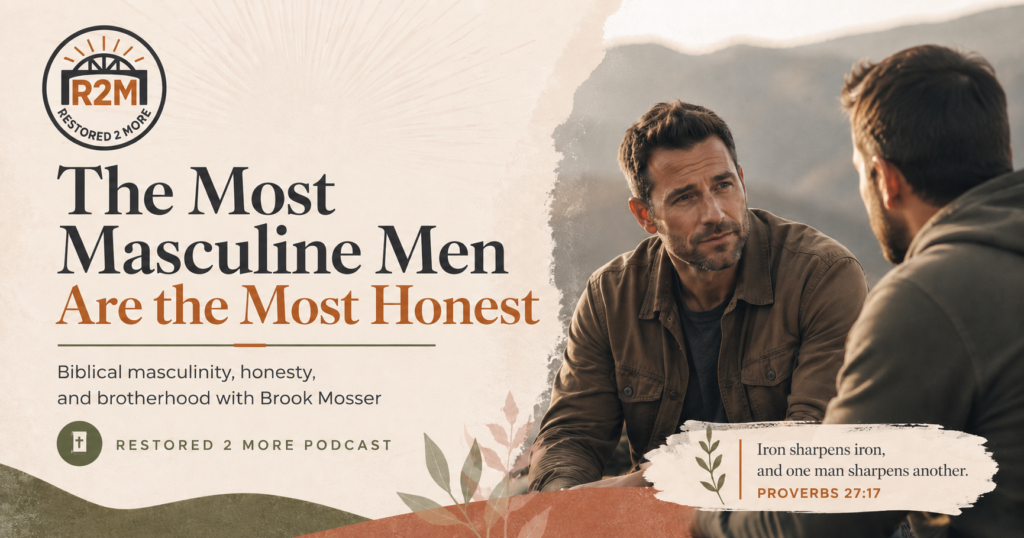
When many people picture masculinity, they think of toughness, independence, confidence, and emotional control.
A strong man does not need help.
A strong man keeps going.
A strong man does not cry.
A strong man handles his problems privately.
But is that really biblical masculinity?
In our conversation with Brook Mosser, founder of Intentional Fatherhood and co-host of the Intentional Parents Podcast, we explored a very different vision of what it means to be a godly man.
Biblical masculinity is not defined by silence, performance, or stereotypically “manly” activities. It is marked by humility, honesty, meekness, confession, and the courage to be fully known.
As Brook shared during the episode:
“The most masculine men are the ones who are the most honest.”
That kind of honesty does not make a man weak. It makes him safe, trustworthy, and increasingly free.
The Problem With Hiding
Many men have learned to hide what is happening beneath the surface.
They may appear responsible, hardworking, faithful, and composed while privately carrying fear, shame, anger, temptation, disappointment, or emotional exhaustion.
Some men were never taught how to identify what they feel. Others learned early that vulnerability would be mocked, dismissed, or used against them. Still others were trained to believe that asking for help was a sign of failure.
So they cope.
They work longer hours. They withdraw. They become irritable. They numb themselves with entertainment, food, alcohol, pornography, or other forms of escape.
These coping mechanisms may offer temporary relief, but they do not bring lasting emotional, spiritual, or relational healing.
Brook explained that many forms of escape provide biological relief for a moment, but they do not address what is happening emotionally, spiritually, or relationally.
What is hidden rarely disappears. It usually grows.
Unspoken pressure becomes resentment.
Unprocessed pain becomes anger.
Isolation becomes secrecy.
Secrecy becomes bondage.
A man may look strong on the outside while slowly collapsing on the inside.
Real Masculinity Is Strength Under Control
Brook offered a much richer definition of masculinity:
“Real masculinity—godly masculinity—is humble. It’s meekness. It’s strength under control.”
Meekness is not passivity.
It is not weakness, avoidance, or indecision.
Meekness is strength submitted to God.
It is having the power to dominate, intimidate, withdraw, or retaliate, but choosing instead to serve, listen, protect, repent, and love.
That kind of strength is clearly seen in Jesus.
Jesus was not emotionally detached. He grieved. He wept. He expressed anguish. He asked His friends to remain close to Him in His most painful hour.
He was also courageous, truthful, sacrificial, and completely surrendered to the Father.
Biblical masculinity does not require men to become less emotionally aware. It calls them to become more spiritually mature in how they respond to those emotions.
A godly man can say:
“I am angry, but I will not use my anger to harm you.”
“I feel overwhelmed, and I need support.”
“I am tempted to escape, so I am going to reach out instead.”
“I was wrong. Will you forgive me?”
“I do not know what to do, but I am willing to learn.”
That is not weakness.
That is integrity.
Men Need More Than Accountability
Accountability is important, but many men need something deeper.
Traditional accountability can sometimes become focused only on behavior:
Did you mess up?
Did you look at pornography?
Did you lose your temper?
Did you follow the plan?
Those questions matter, but they may not reach the deeper places where change begins.
Healthy brotherhood asks more:
What is happening inside you?
What are you carrying right now?
Where are you feeling afraid, ashamed, or overwhelmed?
What are you tempted to do when you feel this way?
How can I pray for you?
What truth do you need to remember?
Accountability may monitor behavior.
Brotherhood helps a man understand his heart.
In the episode, Brook described the importance of having trusted men who can hear the truth without reacting in fear, disgust, or judgment. He shared a personal example of calling a friend during a difficult moment in his marriage and honestly naming the destructive impulses and escape fantasies rising inside him—not because he intended to act on them, but because he refused to hide them. His friend reminded him who he was, encouraged him toward safety, prayed for him, and followed up.
That is what safe fellowship can look like.
A man does not need friends who only know his strengths.
He needs brothers who can hear the truth about his struggles and still call him toward Jesus.
Men Do Not Lack Desire—They Lack Models
One of the most powerful statements Brook made was:
“Men don’t lack good hearts or desire—they lack models.”
Many men genuinely want to be better husbands, fathers, leaders, and friends.
They want to communicate well.
They want to regulate their emotions.
They want to lead spiritually.
They want to create safety in their homes.
They want to live with integrity.
But wanting something and knowing how to do it are not the same.
A man may have never seen another man apologize sincerely.
He may have never watched a father process anger without intimidation.
He may have never experienced friendship where men discussed fear, failure, marriage, purity, finances, grief, or disappointment.
He may have grown up around men who were physically present but emotionally unavailable.
This is why examples matter.
Men need to see godly masculinity practiced in real life.
They need other men who will say:
“This is how I repaired things after hurting my wife.”
“This is what I do when I feel emotionally flooded.”
“This is how I talk to my children after I lose my temper.”
“This is how I ask for help before I make a destructive decision.”
“I am still growing too. Let’s walk this out together.”
Men do not need perfect role models.
They need honest ones.
How Men Can Begin Building Deeper Brotherhood
Many men know they need deeper relationships but have no idea how to begin.
Brook offered a practical first step: define the relationship.
Before suddenly sharing deeply with a casual friend, a man can communicate his intention clearly.
He might say:
“I want to grow as a husband, father, and man of God. I need a place where I can talk honestly about what is happening in my life, pray, and receive support. Would you be open to building that kind of friendship together?”
That simple conversation gives both men the opportunity to agree to the kind of relationship they are building.
From there, consistency matters more than complexity.
A meaningful check-in does not need to last two hours.
Brook described a regular conversation built around three simple questions:
What is going well?
What is hard right now?
What are you dreaming about that feels difficult or even embarrassing to say aloud?
That kind of rhythm creates space for celebration, honesty, vision, prayer, and connection.
The goal is not to create another formal program.
The goal is to stop doing life alone.
How Wives Can Encourage Without Shaming
Many wives can see that their husbands need healthy male friendships long before their husbands are willing to admit it.
This can create frustration.
A wife may be tempted to say:
“You need to call someone.”
“You need help.”
“You cannot keep doing this.”
“You need to go talk to your group.”
Even when the concern is valid, the tone and posture matter.
Brook encouraged wives to examine their own hearts before raising the issue.
Is the invitation coming from care or frustration?
Is the goal to support him, or simply to get him to stop behaving in a way that is painful?
Men often perceive far more than they can articulate. They can usually sense when a suggestion is rooted in disappointment, control, or shame.
A gentler approach may sound like:
“I can see that you are carrying a lot right now.”
“I think time with a trusted friend could be really good for you.”
“I am willing to make space for that.”
“You do not have to carry everything by yourself.”
Encouragement creates an invitation.
Shame creates resistance.
This does not mean wives should ignore harmful behavior or avoid boundaries. It means that support is most effective when it is offered with wisdom, clarity, and respect.
Confession Is Part of Healing
Scripture tells us to confess our sins to one another and pray for one another so that we may be healed.
Confession is not merely admitting failure.
It is stepping out of isolation.
It is bringing what has been hidden into the light.
It is allowing another person to remind us of truth when shame has distorted our thinking.
Confession says:
“This is what happened.”
“This is what I am feeling.”
“This is what I am tempted to do.”
“This is where I need help.”
Healing often begins when a person stops pretending.
That does not mean every struggle should be shared publicly. Wisdom, safety, and appropriate boundaries still matter.
But every man needs at least a few safe people with whom he can be fully honest.
People who will not excuse sin, but also will not crush him under shame.
People who will challenge him, pray for him, remind him of his identity, and help him take the next faithful step.
The Courage to Be Fully Known
The strongest men are not the men who never struggle.
They are the men who refuse to let struggle turn into secrecy.
They are willing to tell the truth before temptation becomes action.
They are willing to confess before shame becomes isolation.
They are willing to receive correction without defensiveness.
They are willing to admit that they need God and other people.
That is the kind of masculinity our marriages, families, and churches desperately need.
Not performative strength.
Not emotional silence.
Not polished appearances.
We need men who are humble enough to be known, courageous enough to confess, and secure enough in Christ to receive help.
The most masculine men are not the ones who hide their weakness.
They are the ones who tell the truth and allow God to meet them there.
Listen to the full episode:
The Most Masculine Men Are the Most Honest with Brook Mosser on the Restored 2 More Podcast.