Is an accidental chasm being created between spouses within the Christian recovery community? How do you know when you and your spouse are ready for couples work? And what do you do when one spouse is ready to heal together, but the other is not?
These are some of the most meaningful questions we have recently been asked about betrayal recovery, relational healing, and why we created The Bridge Back to Us.
Individual recovery is essential after betrayal.
The unfaithful spouse may need support for sobriety, accountability, emotional health, underlying wounds, and lasting freedom. The betrayed spouse may need a safe place to process trauma, grief, anger, confusion, and the loss of the relationship they thought they had.
Both spouses need individual care.
But what happens when they are sent in completely separate directions and never learn how to understand one another’s healing?
What happens when one spouse is growing, changing, and finding freedom—but the marriage remains disconnected?
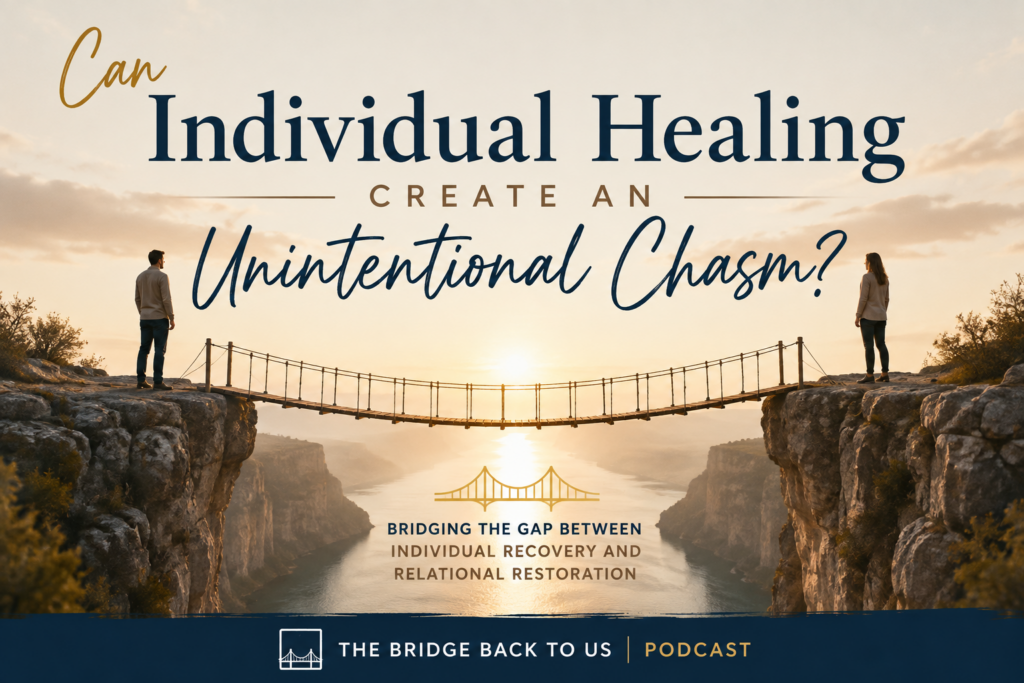
Sometimes, without anyone intending for it to happen, individual healing can create an unintentional chasm between spouses.
When Recovery Happens on Opposite Sides
Many couples begin recovery by finding separate resources.
The unfaithful spouse may enter a men’s group, begin counseling, work through an addiction recovery program, or build a strong accountability community. The betrayed spouse may join a trauma recovery group, read books, listen to podcasts, or begin individual therapy.
Again, these are important and necessary steps.
The problem is not individual healing. The problem is when individual healing becomes the only kind of healing a couple pursues.
Each spouse begins learning new language, developing new coping skills, understanding their story, and growing in ways the other person may never see.
One spouse may become a completely different person through recovery—but if they have not invited their spouse into that growth in an appropriate way, the relationship can begin to feel even more distant.
They may eventually look across the divide and think:
“I do not know who you are anymore.”
Or:
“I am glad you have found freedom, but I still feel alone.”
We have spoken with couples who are years into recovery. The unfaithful spouse has maintained sobriety, joined groups, and made significant personal changes, yet the marriage still feels emotionally disconnected.
Sobriety matters deeply, but sobriety alone does not automatically rebuild trust, empathy, friendship, communication, or intimacy.
Personal growth does not automatically create relational restoration.
At some point, couples need support learning how to build a bridge back to one another.
Why We Created The Bridge Back to Us
The heart behind The Bridge Back to Us came from recognizing this missing part of the recovery journey.
We saw husbands learning about themselves without learning what betrayal trauma had done to their wives.
We saw wives processing their pain without being given safe opportunities to understand their husbands’ stories, wounds, recovery, and transformation.
We saw two people doing meaningful work—but doing it beside one another rather than with one another.
Couples need more than information about themselves.
They also need to learn:
- What their spouse is experiencing
- How betrayal has affected the relationship
- How to communicate about recovery safely
- How to listen without becoming defensive or overwhelmed
- How to develop empathy for one another
- How to rebuild trust through consistent relational safety
- How to remain connected while continuing individual work
This does not mean spouses should become one another’s therapist or accountability partner.
It means they should not remain completely uninformed about one another’s healing.
A healthy couple can learn how to share what they are discovering, communicate what they need, and invite one another into the journey without creating unhealthy dependence.
How Do You Know When You Are Ready for Couples Work?
Couples often ask us whether they need to reach a certain number of months in recovery before beginning relational work.
Timing does matter. Safety matters. Sobriety matters.
However, readiness is not determined only by the calendar.
A couple may be several months into recovery and still be emotionally unprepared to work together. Another couple may be earlier in the process but already demonstrating humility, honesty, surrender, and a genuine desire for restoration.
One of the greatest indicators of readiness is heart posture.
For the unfaithful spouse, readiness may look like:
- A willingness to do whatever it takes for as long as it takes
- Honesty rather than secrecy or minimization
- A desire to understand the betrayed spouse’s pain
- Humility when confronted with the impact of the betrayal
- A commitment to creating safety beyond simply maintaining sobriety
- Openness to accountability, correction, and continued growth
For the betrayed spouse, readiness may look like:
- A desire to heal, even while still feeling angry or heartbroken
- A willingness to participate in difficult but safe conversations
- Curiosity about the unfaithful spouse’s recovery and story
- A desire for forgiveness, even if forgiveness still feels far away
- Openness to learning new ways of communicating and connecting
- A genuine hope for restoration
Couples do not need to be emotionally perfect before beginning couples work.
The betrayed spouse may still experience triggers, grief, fear, and anger. The unfaithful spouse may still be learning how to tolerate shame, respond with empathy, and remain emotionally present.
The question is not, “Are we completely healed?”
The question is, “Are both of our hearts willing?”
Are we willing to learn?
Are we willing to become curious about one another?
Are we willing to tell the truth?
Are we willing to receive what the other person shares?
Are we willing to allow Jesus to soften and transform our hearts?
When One Spouse Is Ready and the Other Is Not
One of the hardest situations in recovery is when one spouse desperately wants relational healing and the other spouse refuses to participate.
We receive messages from betrayed spouses who have listened to every podcast, read the books, joined a group, and begun their healing—but their spouse remains defensive, secretive, or unwilling to change.
We also hear from unfaithful spouses who have pursued sobriety and personal transformation, but their betrayed spouse is too hurt, resentful, or afraid to begin couples work.
There is no simple answer for these situations.
You cannot force another person to heal.
You cannot soften another person’s heart.
You cannot make someone participate in restoration.
But you can remain faithful to what God is asking of you.
For the betrayed spouse, this may mean continuing to pursue personal healing, developing emotional and spiritual health, creating appropriate boundaries, and seeking the Lord before making major decisions.
Your spouse’s choices matter, but their choices do not remove your responsibility to steward your own heart, pain, purpose, and relationship with Christ.
You do not have to make decisions simply because other people pressure you to move faster.
You can ask:
“God, what are You asking of me in this season?”
“Who are You forming me to become?”
“What does faithfulness look like today?”
For the unfaithful spouse whose husband or wife is not ready, the invitation is similar.
Abide in Christ.
Continue doing your own work.
Remain committed to honesty, sobriety, emotional maturity, and lasting transformation.
Pray for your spouse.
Pray that they will take their pain to Jesus. Pray that they will be supported through their grief. Pray that the Lord will soften their heart and guide their decisions.
And become educated about what they are experiencing.
Do Not Let Their Stuck Get You Stuck
When someone we love appears stuck, it is easy to become frustrated, hopeless, or resentful.
We may begin trying to control their timeline or convince them to respond differently.
But if someone is sinking in the sand, jumping into the sand with them will not help either of you.
You may not be able to change your spouse, but you can grow in your understanding of them.
For an unfaithful spouse, learning about betrayal trauma can be incredibly empowering. It can help you understand why your spouse reacts strongly, struggles to trust, asks repeated questions, experiences triggers, or seems unable to move forward at the pace you expected.
Education can increase empathy.
It can help you pray more specifically.
It can change the way you communicate.
It can remind you that your spouse’s pain is not necessarily evidence that your recovery is failing. Grief takes time, and healing is rarely a straight line.
The same is true for a betrayed spouse.
Learning about addiction, compulsive behavior, shame, childhood wounds, emotional immaturity, and the recovery process does not excuse betrayal.
Understanding is not the same as minimizing.
But understanding can help you recognize that your spouse’s story may contain wounds, patterns, and experiences that began long before your marriage.
When we understand more, we often become better equipped to respond with wisdom, boundaries, compassion, and truth.
Why Couples Groups Can Be So Powerful
The idea of sitting in a room—or even on a Zoom call—with other couples can feel terrifying.
Couples may wonder:
“Will hearing other stories trigger us?”
“What will people think about us?”
“Will my spouse share too much?”
“Will I feel safe?”
These are understandable fears.
But we have repeatedly witnessed something powerful happen when couples heal in community.
Sometimes a spouse has been trying to explain their experience for months, but the other spouse cannot fully hear them because the pain feels too personal.
When a betrayed wife shares her grief, her own husband may immediately feel guilt, shame, or defensiveness. He may emotionally shut down before he can receive what she is saying.
But when another betrayed spouse shares a similar experience in a group, he may hear it differently.
It is not being spoken directly at him.
He can listen without immediately defending himself.
Suddenly, he begins to understand what his wife has been trying to communicate.
The same can happen for a betrayed spouse.
Her husband may have shared parts of his childhood, his wounds, or the internal battle behind his behavior, but hearing another man describe a similar story can help her understand her own husband with new empathy.
The betrayal is still personal.
The harm is still real.
But the other person’s story can help lower a wall that has prevented the couple from hearing one another.
We have seen spouses reach for each other’s hands.
We have watched tears form as empathy begins to replace defensiveness.
We have heard husbands say, “You have been trying to tell me this, but I am finally hearing it.”
We have watched wives realize, “I knew parts of his story, but I did not understand how deeply those experiences affected him.”
These moments are not something we can manufacture.
They are holy moments in which God uses community to soften hearts and help couples hear one another differently.
Creating Safety Within Community
Healing in community should not mean exposing couples to unnecessary harm or emotional chaos.
Groups need thoughtful structure, healthy leadership, clear boundaries, and practical tools that help participants remain relationally present.
This is why we begin and end our groups by helping couples turn on their relational circuits.
When someone moves into fight, flight, or freeze, their ability to think relationally decreases. They may become defensive, shut down, panic, attack, or emotionally disconnect.
It is also much harder to learn or retain information when the nervous system is overwhelmed.
Couples need tools that help them slow down, regulate, become present, and remember that they are not alone.
They also need to leave group with hope.
The goal is not for couples to spend two hours discussing painful topics and then leave feeling more disconnected than when they arrived.
We want couples to leave remembering what is good, what God is doing, and what they are building together.
Triggers may still happen.
Hard emotions will still surface.
But safety does not mean avoiding every difficult feeling. It means creating an environment where those feelings can be processed with support, wisdom, and relational connection.
Healing Together Does Not Replace Individual Recovery
Couples work is not a replacement for individual counseling, support groups, accountability, or trauma care.
Both forms of healing matter.
The goal is integration.
Individual recovery helps each spouse become healthier.
Relational recovery helps those healthier individuals learn how to build a healthier marriage.
A couple may need separate resources and shared resources.
They may need individual support and relational support.
They may need private spaces to process and intentional spaces to come back together.
Healing after betrayal is not about choosing between individual recovery and couples work.
It is about recognizing that a restored marriage will eventually require both.
Building a Bridge Back to One Another
An unintentional chasm does not have to become a permanent divide.
Couples can learn how to bring one another into their growth.
They can become curious instead of critical.
They can listen instead of immediately defending.
They can learn about one another’s pain, experiences, fears, and needs.
They can seek support from people who understand both individual healing and relational restoration.
Most importantly, they can continue inviting Jesus into the places that feel impossible to repair.
Restoration does not happen because two people execute every recovery step perfectly.
It happens through surrender.
It happens through humility.
It happens as hardened hearts become soft.
It happens when spouses tell the truth, practice empathy, create safety, extend patience, and take intentional steps toward one another.
You may currently feel like you and your spouse are standing on opposite sides of a chasm.
But that does not mean the distance cannot be crossed.
With wise support, willing hearts, and Jesus at the center, you can begin building a bridge back to one another.