
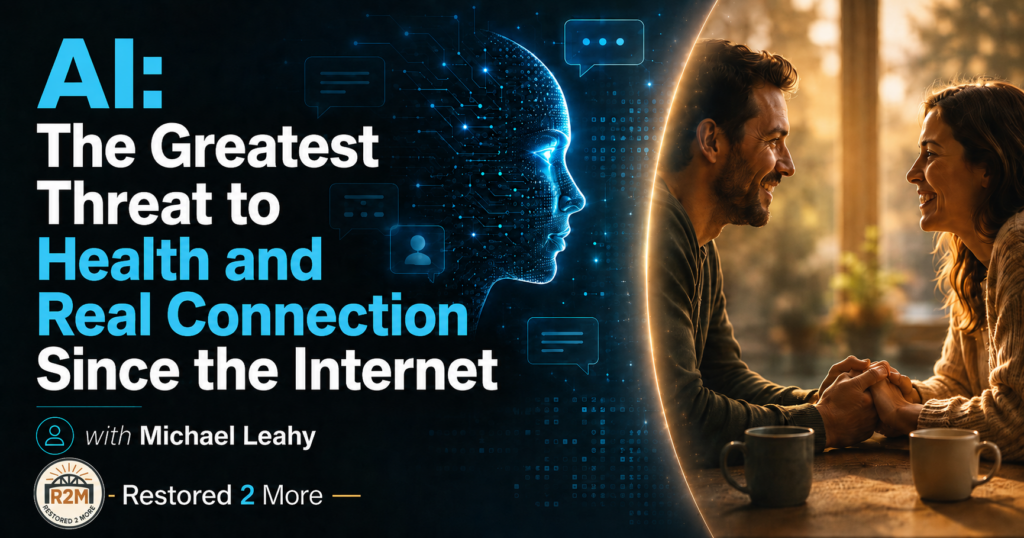
AI: The Greatest Threat to Health and Real Connection Since the Internet
Artificial intelligence is no longer just something people use to write emails, create documents, or summarize information.
It is quickly becoming something people relate to.
And that is where the danger begins.
In our recent conversation with Michael Leahy, founder and CEO of BraveHearts and author of Porn Nation, we talked about one of the most urgent issues facing marriages, families, recovery, and the Church today: the rise of AI-generated pornography, AI companions, and counterfeit connection.
Michael has spent decades helping men, women, and couples heal from sexual addiction and betrayal trauma. But as someone who also came from the technology world and lived through the early days of internet pornography, he sees something coming that many people are not prepared for.
AI may be the greatest threat to health and real connection since the internet.
And not simply because of what AI can produce, but because of what AI can become.
Pornography Was Never Just a Behavior Issue
One of the most powerful parts of our conversation was when Michael talked about having a “relationship with pornography.”
That language may feel strange at first. Most people think of pornography as a behavior, a temptation, a struggle, or an addiction. But for many, pornography becomes something much deeper.
It becomes a place to run.
A place to escape.
A place to cope.
A place to feel wanted, comforted, powerful, distracted, or numb.
For many men and women, pornography was there in moments of loneliness, rejection, fear, stress, anger, or pain. It became a counterfeit comfort. A false companion. Something that felt like relief, even while it was slowly destroying intimacy, integrity, trust, and connection.
Michael shared that one of the most important questions we can ask is:
“Tell me about your relationship with pornography.”
Because everyone has a relationship with it. Even if someone has never viewed it, that still defines their relationship with it. For others, the relationship may be marked by secrecy, shame, addiction, recovery, accountability, or healing.
But now Michael believes there is another question we must begin asking:
“Tell me about your relationship with AI.”
AI Is Creating the Attachment Economy
One of the most sobering lines from this episode was this:
“If social media created the attention economy, AI is creating the attachment economy.”
That sentence captures the weight of what we are facing.
Social media was designed to keep our attention. To keep us scrolling, clicking, comparing, reacting, and returning.
But AI is different.
AI does not just capture attention. It can create attachment.
It can talk back.
It can ask questions.
It can remember what you shared.
It can affirm you.
It can learn your desires.
It can respond in a way that feels personal, caring, validating, and emotionally present.
And that means AI is not just becoming a tool people use. It can become a companion people turn to.
For someone who is lonely, hurting, addicted, betrayed, rejected, unseen, or emotionally starved, that can become incredibly dangerous.
AI-Generated Pornography Is Only Part of the Concern
When people hear about the dangers of AI and pornography, they often think only about AI-generated images or videos.
That is a real concern.
AI can now be used to create personalized sexualized content, fantasy-based material, interactive stories, and images that feel more personal and immersive than traditional pornography.
For a betrayed spouse, this can create another layer of trauma. It may feel more violating, more confusing, and harder to process because it is not just content someone found. It can be content someone created, customized, or personalized.
But Michael helped us see that AI-generated pornography is only part of the issue.
The bigger danger may be that AI can become relational.
Pornography was already a counterfeit of intimacy. But now the counterfeit can talk back.
It can respond to your mood.
It can use your name.
It can adapt to your preferences.
It can affirm your pain.
It can create the illusion that you are known.
That takes the battle from behavior into attachment.
And attachment is much harder to break.
The Danger of a Frictionless Relationship
Michael described AI as a “frictionless relationship.”
That phrase is so important.
Real relationships include friction. Not because friction is always bad, but because real love requires honesty, repair, patience, humility, confession, forgiveness, and growth.
A spouse may challenge you.
A friend may lovingly confront you.
A counselor may help you see what you are avoiding.
A mentor may ask the hard question.
A real person may not always tell you what you want to hear, but they can help you become who God created you to be.
AI is different.
AI can be trained to agree.
It can affirm without challenging.
It can validate without wisdom.
It can comfort without truth.
It can keep you engaged without helping you heal.
That is part of what makes it so dangerous. A person can begin turning to AI because it feels easier than dealing with the pain, conflict, disappointment, and vulnerability of real relationships.
But frictionless connection is not the same as real intimacy.
Betrayed Spouses May Be Vulnerable Too
One of the most eye-opening parts of this conversation was when Michael talked about betrayed spouses.
Often, when we discuss pornography, addiction, and AI, we focus on the spouse who is struggling with unwanted sexual behavior. And that matters deeply.
But Michael warned that betrayed spouses may also become vulnerable to AI companionship.
Why?
Because many betrayed spouses have lived for years without emotional connection, affirmation, honesty, tenderness, safety, or attunement. Their world has been shattered. Their nervous system is overwhelmed. Their trust has been broken. They may feel unseen, unwanted, alone, and desperate for comfort.
AI can step into that pain and offer immediate affirmation.
It can be available at 3:00 a.m.
It can listen without interruption.
It can remember details.
It can say comforting words.
It can feel emotionally present.
But it is not real.
It cannot offer embodied presence. It cannot offer soul-level connection. It cannot truly love, grieve, pray, repent, repair, or walk with someone through pain.
And that is why we must take this seriously.
Betrayed spouses do not need artificial comfort that keeps them isolated. They need safe, wise, compassionate, real human support.
What This Means for Parents
This conversation also has major implications for our kids.
Many young people are already interacting with AI. And as AI becomes more realistic, more conversational, more visual, more personalized, and more emotionally responsive, the line between tool and companion will become harder to discern.
As parents, we cannot afford to be passive.
We need to teach our kids the difference between real and artificial.
Real relationships require courage.
Real relationships include disappointment.
Real relationships involve repair.
Real relationships ask us to listen, confess, forgive, grow, and love.
AI may feel easier, but easier does not mean healthier.
Our kids need to know that being human means learning how to live in real relationship with real people. They need to experience eye contact, empathy, conflict resolution, emotional honesty, physical presence, spiritual connection, and embodied love.
They need to know that real connection is worth the risk.
The Hope: AI Cannot Replace the Soul
This episode was sobering. There is no way around that.
But it was not hopeless.
Michael reminded us that there is nothing that can compare to being human with another human.
AI can generate words, but it cannot carry the image of God.
AI can simulate empathy, but it cannot truly love.
AI can offer affirmation, but it cannot offer soul-level presence.
AI can imitate connection, but it cannot become the Body of Christ.
And that is where the Church has an incredible opportunity.
In a world running toward artificial intimacy, real human connection may become one of the greatest witnesses we have.
The Church can offer what AI never can:
Real presence.
Real community.
Real confession.
Real forgiveness.
Real discipleship.
Real love.
Real healing.
A real God.
How Do We Respond?
We do not need to panic, but we do need to pay attention.
We need to ask better questions.
We need to talk openly with our spouses and kids.
We need to bring AI into recovery conversations.
We need to help people understand the difference between using AI as a tool and turning to AI as a companion.
We need to create safe spaces where people can be honest about pornography, fantasy, loneliness, emotional dependency, and artificial connection.
And most of all, we need to fight for what is real.
Because the answer to counterfeit intimacy is not fear.
It is deeper connection.
It is safer marriages.
It is healthier families.
It is embodied community.
It is men and women learning how to bring their pain, loneliness, desires, and wounds into the light with God and safe people.
AI may be one of the greatest threats to health and real connection since the internet.
But it may also become one of the greatest invitations for the Church to remember who we are.
We were not created for artificial intimacy.
We were created for God.
We were created for each other.
We were created for real connection.
Listen to the Full Episode
To hear the full conversation with Michael Leahy, listen to the Restored 2 More Podcast wherever you get your podcasts.
And if this conversation stirred something in you, do not ignore it. Talk to your spouse. Talk to your kids. Talk to a safe mentor, counselor, pastor, or recovery leader.
This is not a conversation for someday.
This is a conversation for now.