What if pornography isn’t just something you need to stop—but something you need to outgrow?
For many men, pornography became part of their story long before they had the maturity, language, or support to understand what was really happening beneath the surface. What began as curiosity, escape, or self-soothing can eventually become a deeply ingrained pattern that feels almost impossible to break.
And when that happens, the natural response is often to fight harder.
Try harder.
Be more disciplined.
Install another filter.
Make another promise.
But what if lasting freedom requires something deeper?
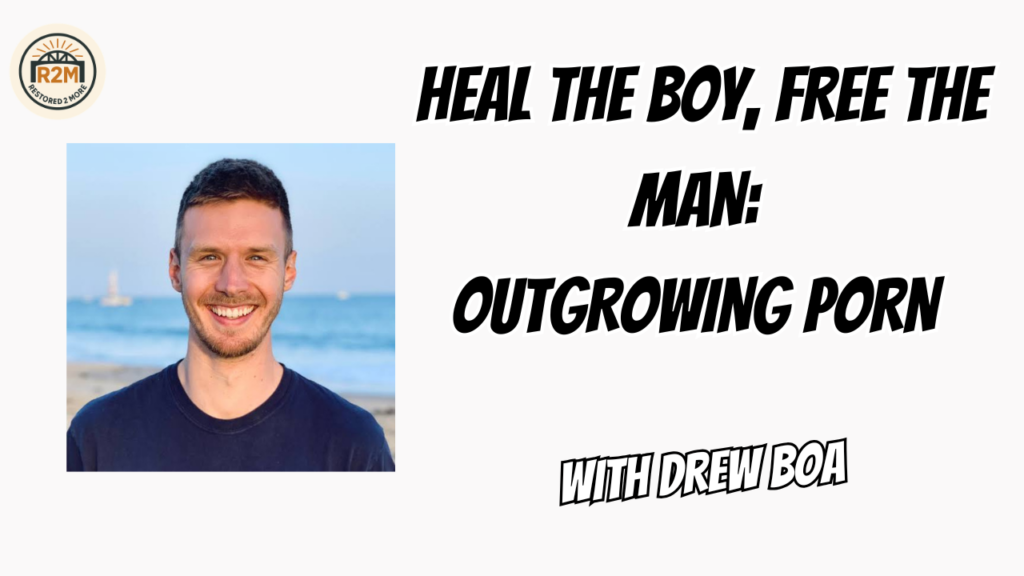
In our conversation with Drew Boa, founder of Husband Material and author of Outgrow Porn: Find Lasting Freedom Without Fighting an Exhausting Battle, we explored a different approach to recovery—one rooted in understanding, maturity, compassion, emotional healing, and the presence of Jesus.
One of Drew’s most powerful phrases captured the heart of the entire conversation:
“Heal the boy to free the man.”
Porn as a Pacifier
The cover of Drew’s book features a pacifier, and there is a reason for that.
Drew explained that pornography can function much like a pacifier does for a child.
A pacifier does not actually solve hunger, loneliness, pain, exhaustion, or fear. It simply helps quiet the discomfort for a moment.
Pornography can function the same way.
For many people, pornography was first discovered during childhood or adolescence—a season when they may not yet have had the emotional skills to identify what they were feeling or communicate what they needed.
Porn can then become a way of saying:
Make this feeling stop.
Maybe the underlying feeling is loneliness.
Maybe it is rejection.
Maybe it is insecurity.
Maybe it is powerlessness.
Maybe it is the ache to feel desired, chosen, included, successful, comforted, or important.
The pornography itself may offer temporary relief, but the deeper need remains untouched.
Drew described pornography as both a pacifier and a predator. Many people encountered pornography long before they had any real understanding of what it could do to their brains, sexuality, relationships, or sense of self.
That does not remove personal responsibility for recovery. But it can change the way we understand the beginning of the story.
Instead of beginning with shame, recovery can begin with curiosity.
What was I trying to soothe?
What was I longing to feel?
What was pornography offering me emotionally?
Your Fantasies May Be Telling a Story
One of the most interesting parts of our conversation was Drew’s explanation of sexual fantasy.
For years, Drew carried shame around a very specific fantasy that felt unusually powerful to him. He did not understand why it had such a strong pull.
Eventually, instead of only asking, How do I get rid of this?, he began asking a different question:
What does this fantasy make me feel?
That question changed everything.
For Drew, the fantasy carried deeper messages of being accepted, included, and powerful.
Then he asked the opposite question:
When did I feel rejected, excluded, and powerless?
That led him back to a painful season around age thirteen when he had moved to another country, entered a completely unfamiliar environment, felt isolated, and increasingly escaped into video games and pornography.
The fantasy was not random.
It was connected to his story.
This does not mean that understanding the origin of a fantasy makes harmful sexual behavior acceptable. It does mean that understanding the story underneath the behavior can give us new places to pursue healing.
Clint shared a similar realization from his own recovery.
When he began looking underneath the pornography he had used, he recognized deeper longings to feel wanted, desired, chosen, and successful.
Those longings were connected to seasons of his life when he felt the opposite.
This distinction matters.
Understanding is not excusing.
Understanding gives us the opportunity to meet legitimate needs in healthier, redemptive ways.
Porn Gets Power From Unprocessed Feelings
Drew shared a statement that stood out to us:
“Porn gets its power from unprocessed feelings.”
When we do not know what we are feeling, we are far more vulnerable to reaching automatically for whatever has helped us escape those feelings in the past.
Drew distinguishes between two kinds of triggers: pain triggers and pleasure triggers.
A pleasure trigger is something that feels unusually compelling or irresistible.
A pain trigger is an emotion or experience that feels far bigger than the present situation seems to warrant.
Maybe a relatively small rejection feels devastating.
Maybe criticism feels unbearable.
Maybe feeling overlooked creates intense anger.
Maybe loneliness suddenly feels intolerable.
Those strong reactions can sometimes reveal that the current moment is touching something deeper.
And because human beings are often more motivated to escape pain than pursue pleasure, the pain underneath an urge can be incredibly important to understand.
Instead of only asking:
What am I tempted by?
It may also help to ask:
What am I trying not to feel?
Stop Fighting the Wave
When a strong urge hits, deeper story work is important—but sometimes you need something practical you can use immediately.
Drew uses the picture of surfing.
An urge is like a wave.
If you stand in the ocean and try to fight directly against the wave, eventually it will overpower you.
Instead, you learn how to work with it.
Drew calls this urge surfing.
Rather than panicking when an urge appears or immediately trying to force it away, you learn to slow down, regulate your body, observe what is happening, and make an intentional decision.
To help people do this, Drew developed a simple tool called BOA.
Breathe. Observe. Attune.
BOA stands for:
Breathe. Observe. Attune.
It can be practiced in a minute—or sometimes even in a few seconds.
Breathe
Start by taking a few slow, deep breaths.
Breathing helps regulate the nervous system and creates a little space between the feeling you are experiencing and the action you might take.
Instead of immediately battling the urge, you are slowing your body down enough to make a choice.
Drew also connected this practice beautifully to our spiritual lives. The biblical words associated with spirit are closely connected with breath and wind.
Breathing can become a simple reminder:
God is here.
I do not have to panic.
I do not have to respond automatically.
Observe
Next, notice what is happening around you and inside you.
What do you see?
What do you hear?
What do you physically feel?
What emotion is present?
What is happening in your body?
Observation brings you back into the present moment.
Sometimes an urge is connected to an older story, and suddenly part of us feels like that lonely thirteen-year-old, rejected child, powerless teenager, or frightened young person again.
Observation helps remind us:
I am here now.
I am not that child anymore.
I have choices.
Attune
Finally, ask:
What do I actually need right now?
This is the opposite of simply handing ourselves another emotional pacifier.
Maybe we need connection.
Maybe we need reassurance.
Maybe we need rest.
Maybe we need to be seen.
Maybe we need to call someone.
Maybe we need comfort.
Maybe we need to process disappointment.
Maybe we need to sit with Jesus.
Drew explained that many of our deepest needs are attachment needs—the need to feel safe, seen, loved, supported, cherished, soothed, and reassured.
Sometimes those relational needs become sexualized rather than honestly acknowledged.
Attunement teaches us how to recognize the need underneath the urge and respond to that need in a healthier way.
Practice Before You Need It
There is one problem with recovery tools.
The moment you most need them is often the moment you are least likely to remember them.
Drew compared learning emotional regulation to learning a sport or musical instrument.
You do not wait until you are standing in the biggest wave of your life to learn how to surf.
You practice on the beach.
The same is true with BOA.
Practice breathing when you are calm.
Practice naming your emotions when your day is going well.
Practice checking in with your needs when you are not triggered.
Practice calling safe people before you are desperate.
Over time, those skills become more natural.
Because of neuroplasticity, repeated practices can eventually become much more automatic.
Recovery is not merely about gaining information.
It is about developing new ways of responding.
Why Childhood Matters
One of the biggest hesitations many people have around deeper recovery work is the idea of revisiting childhood.
Maybe you think:
I had a good childhood.
Nothing terrible happened to me.
Why do I need to go backward?
Drew challenged that perspective.
One of the first questions he asks is:
How old were you when you first encountered pornography?
For many people, the answer is childhood or adolescence.
That exposure itself matters.
And beyond exposure to pornography, many people grew up without healthy conversations about sexuality.
Sex may have been marked by silence, shame, secrecy, fear, or simply a total absence of guidance.
Even in wonderful Christian families, a child can internalize beliefs such as:
I have to be perfect.
I cannot let anyone see this part of me.
If people knew the real me, they would reject me.
Sexual struggle means something is deeply wrong with me.
Those beliefs can follow us into adulthood.
Drew pointed to Psalm 131, where the psalmist describes the soul as a weaned child resting with its mother.
It is a beautiful picture of calm, secure attachment.
In many ways, deeper healing involves learning how to offer that same calm, compassion, and connection to the younger parts of our own story.
And ultimately, inviting Jesus into those places.
Jesus consistently moved toward people carrying sexual shame.
He was compassionate.
He was truthful.
He was tender.
He was never afraid of brokenness.
When Drew talks about healing the younger self, he is not describing an alternative to Jesus.
He is talking about allowing Jesus to meet us in parts of our story we may have spent years avoiding.
From Compliance to Compassion
Drew has now experienced more than ten years of freedom from internet pornography.
But interestingly, he shared that he had previously achieved a year of sobriety and still had not experienced the deeper healing he needed.
The fantasies were still incredibly powerful.
Then his support system disappeared after college, and he relapsed harder than before.
That experience forced him to go deeper.
He began learning more about sexual addiction, understanding his childhood story, developing vulnerability, and experiencing the love of Jesus in those younger places.
His recovery became about more than simply maintaining a sobriety number.
It shifted from compliance to compassion.
That does not mean minimizing sin or abandoning boundaries.
It means understanding that lasting transformation requires more than behavior management.
Freedom includes becoming emotionally, relationally, spiritually, and sexually mature.
Eventually, pornography can begin to lose the power it once had.
You Cannot Heal in Isolation
Pornography thrives in secrecy.
Healing thrives in safe relationship.
Drew talked about how powerful it can be to finally say something vulnerable to another safe person and discover that they do not run away.
Maybe you have carried a belief that says:
If someone really knew me, they would be disgusted.
Then you tell the truth.
And instead of disgust, you receive compassion.
Instead of rejection, you experience connection.
That moment begins challenging the lie that you are disqualified from love.
For men especially, this level of vulnerability can feel foreign.
Many men have friendships.
Many attend church.
Many sit in Bible studies.
Many serve faithfully.
And yet very few people actually know what is happening inside them.
Clint shared that during parts of his own story, he appeared to be doing everything right externally while feeling deeply alone internally.
Healing requires finding safe people who can know the real story.
At the same time, Drew offered an incredibly important reminder for couples healing after betrayal:
The betrayed spouse cannot be expected to become the recovering spouse’s entire support system.
A person experiencing betrayal trauma is already carrying enormous pain.
They need support too.
Recovery works best when both spouses have safe people, appropriate resources, and places where their individual healing can be supported.
Recovery Can Be an Adventure
One of our favorite things Drew said throughout the conversation was his repeated use of the word adventure.
Recovery is often described with words like battle, struggle, fight, discipline, and endurance.
And there is truth in all of those words.
Recovery can be painful.
It can include grief, anger, tears, setbacks, difficult conversations, and hard truths.
But what if recovery can also become an adventure?
An adventure of understanding yourself.
An adventure of discovering why certain things have had power over you.
An adventure of learning new emotional skills.
An adventure of experiencing safe relationships.
An adventure of learning how God designed your sexuality.
An adventure of becoming more whole.
An adventure of discovering Jesus in parts of your story you once believed were too shameful for Him to enter.
Like every real adventure, there will be valleys and mountaintops.
There will be moments that feel beautiful and moments that feel painfully dark.
But you do not have to walk through them alone.
Jesus is still the Shepherd.
And He is not afraid to lead us into the places that need healing.
Take a Redemptive Risk
Drew ended our conversation by challenging listeners to take what he calls a redemptive risk.
A redemptive risk is something that feels scary because vulnerability is involved, but you believe taking that step could move you toward healing.
Maybe your redemptive risk is telling the truth for the first time.
Maybe it is calling a counselor.
Maybe it is joining a recovery group.
Maybe it is opening up to a trusted friend.
Maybe it is reading a book that helps you understand your story differently.
Maybe it is finally asking:
What has pornography been pacifying in me?
You do not have to solve your entire story today.
But you can take the next courageous step.
And every step matters.
Freedom is not reserved for people with more willpower than you.
Pornography does not have to control your future.
Healing is possible.
Growth is possible.
And with Jesus, you can begin the journey of healing the boy—and freeing the man.