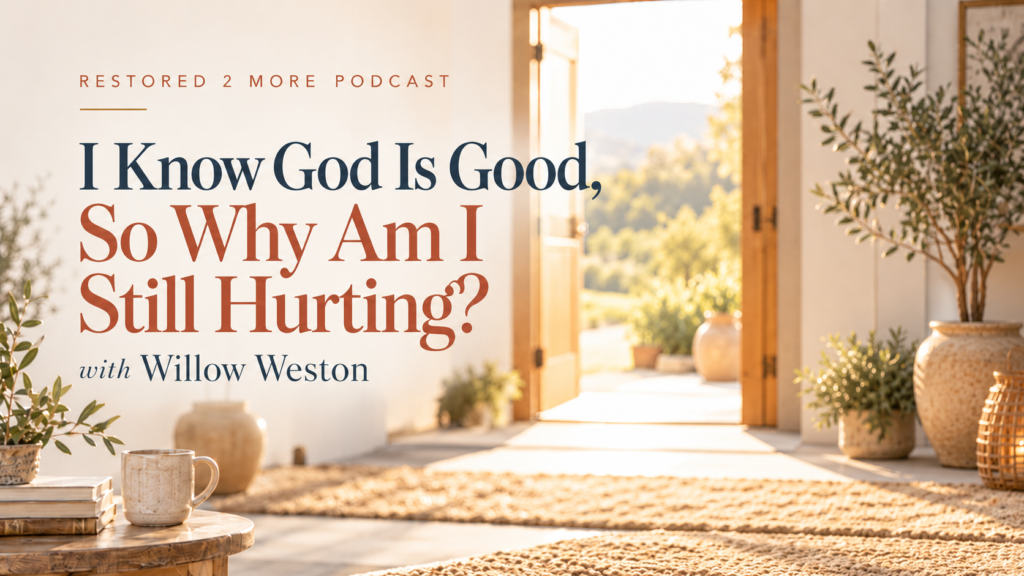
Have you ever felt like you should be okay by now?
You love Jesus. You believe God is good. You’ve prayed, forgiven, read Scripture, and tried to move forward. You’ve reminded yourself of His promises and goodness, yet there’s still pain beneath the surface.
And maybe you’ve wondered, Why am I still hurting? Shouldn’t I be further along by now?
In our own healing journey, we discovered that the pain we had carried for years was impacting us in ways we couldn’t even put words to. We knew God’s truth. We believed in His goodness. But knowing the truth didn’t automatically mean we had processed the wounds we were carrying.
And sometimes, without realizing it, we can use spiritual truths like Band-Aids to cover wounds that God actually wants to heal.
In this week’s episode of the Restored 2 More podcast, we sat down with author, speaker, and founder of Collide, Willow Weston, for a deeply meaningful conversation about childhood wounds, marriage, parenting, and what it looks like to invite Jesus into the places we’ve been afraid to face.
When the Past Shows Up at Your Front Door
Willow shared a powerful story from her own life.
It was an ordinary Wednesday. She was home with her baby when someone knocked at the front door.
She looked through the peephole and saw her mother standing outside.
For most people, that might seem like an ordinary visit. But for Willow, seeing her mother brought years of childhood pain, neglect, abuse, and unresolved wounds flooding back.
Instead of opening the door, Willow ran upstairs and hid in a closet, holding her baby and trying to keep her quiet.
She had been following Jesus for more than a decade. She loved God. She had experienced His goodness and healing.
But in that closet, she realized there were still parts of her story that needed attention.
She felt God inviting her to step out of that closet and get help.
What happened next became a turning point in her life.
Willow began a journey of addressing the wounds she had carried since childhood, recognizing something that would shape her future:
If she didn’t find healing for the wounds she inherited, she risked passing those wounds on to the people she loved most.
And isn’t that true for so many of us?
We may not be hiding in a literal closet, but how often do we hide from the pain we don’t want to face?
We stay busy. We minimize what happened. We tell ourselves it wasn’t that bad. We push through, move on, or try to convince ourselves that because we have Jesus, we should be fine.
But the pain doesn’t necessarily disappear just because we’ve learned how to ignore it.
When Faith Becomes a Spiritual Band-Aid
One of the most impactful moments in our conversation was when Willow shared a story about a woman she met at a retreat.
Ten years earlier, this woman had experienced a devastating tragedy. She had ended a relationship with a man she planned to marry because they didn’t share the same faith. Tragically, he later died by suicide.
When she turned to people in her church for support, she was encouraged to remember that she’d made the right decision, that God was good, and that she needed to move on.
So she tried.
But ten years later, she was still grieving, confused about why the pain hadn’t gone away.
After all, she had Jesus. Shouldn’t she be okay?
Willow helped her recognize something incredibly important:
Having faith doesn’t mean we no longer experience grief. And believing God is good doesn’t mean we have to pretend we’re okay when we’re not.
Sometimes we unknowingly place spiritual Band-Aids over deep wounds. We quote Scripture, remind ourselves of God’s promises, and rush toward the hope of tomorrow without ever acknowledging the hurt of today.
Those truths are good and necessary. But they were never intended to silence our pain.
God isn’t asking us to deny what’s real.
He’s inviting us to bring what’s real to Him.
As Willow shared in the episode:
“You don’t have to pretend you’re good when you’re not.”
What a freeing reminder.
Our grief doesn’t mean we’ve lost our faith. Our struggles don’t mean God has abandoned us. And our need for healing doesn’t mean we’ve somehow failed as Christians.
We can know God is good and still admit that we’re hurting.
The Pain We Don’t Address Doesn’t Stay With Us
Something we’ve learned through our own marriage restoration journey is that unprocessed pain rarely stays neatly contained in the past.
It often finds its way into the relationships that matter most.
It can show up in how we respond to conflict, how we communicate with our spouse, how we parent our children, or how we react when someone unintentionally touches a sensitive place in our story.
Clint shared in this conversation how, for years, he didn’t know how to process pain. He knew how to medicate it, run from it, and pretend it wasn’t there.
And that is true for so many people.
We’re often taught how to be tough, push through, or move on, but we’re rarely taught how to sit with pain, give it a voice, and process it in a healthy way.
Willow described the way wounds can travel from one generation to the next. Her mother had wounds that went unhealed, and those wounds impacted Willow. Without healing, Willow recognized she could continue that same pattern with her own children.
But she also discovered that the pattern could change.
Just because pain was passed down to you doesn’t mean it has to be passed on through you.
That change begins when we’re willing to acknowledge what hurts and invite God into the healing process.
What If Your Spouse Can’t Sit With Your Pain?
Another powerful part of this episode was Willow’s honesty about how her healing journey affected her marriage.
As she began attending therapy and processing painful memories from childhood, she naturally wanted to share those experiences with her husband, Rob.
But Rob had grown up in a family where difficult things weren’t talked about.
So when Willow came home from counseling emotionally raw and wanting connection, he didn’t always know how to respond.
Sometimes he would simply ask if they could talk later because he had a project to finish.
And for Willow, that hurt.
She was already carrying pain, and now she felt alone in it.
But instead of accepting that emotional distance as the way their marriage would always be, Willow began expressing what she needed.
She wanted her husband to become someone who could sit with her in the hard places.
And over time, something beautiful happened.
As Willow began addressing her own wounds, Rob began recognizing areas of his life that needed healing, too.
Her healing journey became an invitation for him to begin his own.
We loved what Willow shared about this process because it wasn’t instantaneous. There wasn’t one perfect conversation that suddenly changed everything.
It required honesty, patience, growth, and a willingness to keep pursuing the kind of marriage they hoped to build.
Sometimes our own healing reveals wounds in the people closest to us.
And while we can’t force someone else to do their healing work, we can continue to pursue health, communicate our needs, and invite them into something better.
Healing can become contagious.
We’ve seen this in our own family, too. What began with one person’s decision to pursue healing eventually opened the door for others to do the same.
That’s part of what makes restoration so beautiful. It doesn’t have to end with us.
God Cannot Heal a Pain That You Won’t Name
One of Willow’s most powerful statements in the episode was:
“God cannot heal a pain that you won’t name.”
How often do we minimize our hurt because we don’t want to feel it?
Maybe we’re afraid that if we begin opening the door to those painful memories, we’ll become overwhelmed.
Maybe we don’t know where to start.
Or maybe we’ve convinced ourselves that what happened wasn’t serious enough to deserve attention.
But healing requires honesty.
It means being willing to acknowledge what happened, how it impacted us, and where we still need help.
For Willow, that included inviting Jesus into her pain and seeking the support of a therapist who could help her process her experiences.
And what we love about her story is that she didn’t have to choose between faith and getting help.
Both became meaningful parts of her journey.
Sometimes taking that first step looks like having an honest conversation with your spouse. Sometimes it’s opening up to a trusted friend, meeting with a counselor, or finally allowing yourself to grieve something you’ve carried for years.
Whatever that first step looks like, you don’t have to have everything figured out before you begin.
You just have to be willing to be honest about where you are.
Jesus Isn’t Running Away From Your Pain. He’s Running Toward It.
Toward the end of our conversation, Clint shared an image that moved all of us.
Throughout the Gospels, we see Jesus continually moving toward people who are hurting.
He approaches the outcast. He sees the overlooked. He moves toward the broken, the ashamed, the grieving, and those everyone else has pushed aside.
Clint compared Jesus to a firefighter running into a burning building.
When everyone else is running away from the flames, the firefighter runs toward them to rescue the person inside.
What if that’s how Jesus is pursuing you in your pain?
What if He’s not standing at a distance, frustrated that you’re still struggling?
What if He’s moving toward the very places you’ve been afraid to let anyone see?
Willow’s response was such a beautiful reminder:
“God is not who wounded you.”
Jesus is not intimidated by our pain, our shame, our struggles, or the messiness of our stories.
He’s not demanding that we clean ourselves up before coming to Him.
He’s inviting us to be honest, to stop hiding, and to let Him meet us in the places that still hurt.
And sometimes that invitation begins with something as simple as saying, “Here I am, Lord. I need Your help.”
Your Healing Could Change More Than Your Own Life
When Willow looks back at that ordinary Wednesday, she recognizes how significant her decision to pursue healing really was.
It didn’t just change her relationship with her past.
It affected her marriage, her children, and the way she could love the people around her.
Eventually, that same journey gave birth to Collide, a ministry that has reached thousands of women with the message of hope and healing in Jesus.
What began with one woman’s willingness to face her pain became an invitation for countless others to do the same.
And we believe that’s part of the beauty of what God can do in all of our stories.
He doesn’t just want to heal us for our own sake.
Our healing can transform the way we love our spouse, raise our children, build friendships, and show up in our communities.
The wounds that once shaped our relationships don’t have to define their future.
And the pain that was handed to us doesn’t have to become the pain we hand to someone else.
So if you’ve been telling yourself that you should be okay by now because you know God is good, we want to encourage you:
You don’t have to pretend you’re okay.
You can be grateful for God’s goodness and still have places in your heart that need healing.
You can love Jesus deeply and still need help.
You can have genuine faith and still carry grief.
And you can begin again, no matter how long you’ve been hurting.
There is hope for your story, and there is more healing to be found.
Sometimes it begins with a simple yes.