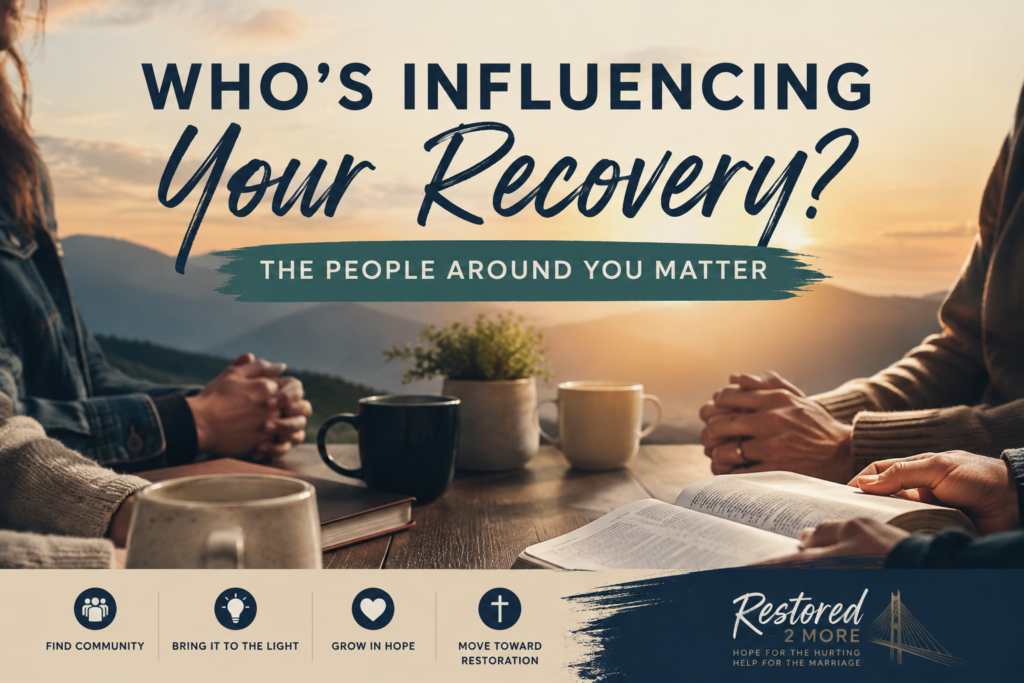
Who you surround yourself with in recovery matters more than you may realize.
The people around us shape the way we think, the way we process pain, the way we view our spouse, and even the way we imagine our future.
That doesn’t mean we should only surround ourselves with people who are positive all the time. Recovery involves grief. It involves anger, sadness, disappointment, fear, and sometimes deep confusion.
But there is an important difference between being surrounded by people who help you process your pain and being surrounded by people who unintentionally help you stay stuck in it.
At some point in recovery, it may be worth asking:
Are the people around me helping me become who I want to become?
Sometimes You Can Outgrow a Recovery Group
Early in my betrayal recovery, I desperately needed women who understood what I was going through.
I remember finding my first recovery group through our church. I was angry, devastated, confused, and honestly frustrated that I even had to be there.
But there was something incredibly important about sitting in a room with women who understood betrayal trauma.
They validated my pain.
They understood the anger.
They understood the grief.
And at that stage of recovery, I needed that.
But eventually something began to change.
As I started healing, I remember looking around the room and realizing that many of the women surrounding me were no longer pursuing the same outcome I was pursuing.
Some were separated. Some were divorced. Some had been carrying deep anger for years.
And I remember thinking:
Who here is fighting for their marriage?
Who here still has hope?
Who here wants restoration?
I eventually brought that struggle to my therapist, and she told me something that gave me tremendous freedom:
I had outgrown my group.
That didn’t mean the group was bad.
It didn’t mean those women were wrong for being where they were.
It simply meant that the community I needed at the beginning of my healing journey was not necessarily the community I needed for the next stage of it.
You Become Like the People Around You
We hear this principle everywhere.
You become like the people you spend the most time with.
We talk about it in business, parenting, friendships, health, and leadership.
Recovery is no different.
If you are surrounded by people who believe restoration is possible, their hope begins to strengthen yours.
If you are surrounded by people practicing honesty, surrender, confession, forgiveness, and healthy boundaries, those practices begin to become normal.
But the opposite can also happen.
If every conversation reinforces bitterness, hopelessness, resentment, or contempt, those attitudes can slowly begin shaping the way you see your own marriage.
Again, this is not an invitation to suppress anger.
Scripture says, “In your anger do not sin.”
That means anger itself is not the enemy.
There are very legitimate reasons to be angry after betrayal.
You may be angry because you were deceived.
You may feel powerless.
You may feel like your life was turned upside down without your consent.
Those emotions deserve space.
But healing asks another question too:
What am I doing with my anger?
Is my community helping me process it in a way that leads toward healing?
Or is it helping me build an identity around it?
Bringing What Is Hidden Into the Light
One of the most powerful lessons from this episode actually came through a parenting moment.
Our eight-year-old accidentally saw a frightening scene on a television while we were at the dentist.
Later that night, he came into our room crying because he could not get the image out of his mind.
We prayed with him, but a few minutes later he came back.
He was still scared.
The image was still there.
And that became an unexpected discipleship opportunity.
Instead of simply praying the fear away for him, we wanted to teach him what he could do when something entered his mind that he didn’t want there.
We talked about spiritual warfare.
We talked about the armor of God.
We talked about the sword of the Spirit and the power of truth.
We also talked about something incredibly practical:
Images can be sticky.
Sometimes we see something accidentally and it stays with us.
Because adults experience this too.
Someone in recovery may see an image that triggers old pathways.
A memory may resurface.
A fantasy may begin.
A temptation may suddenly feel intense.
And the instinct can be:
I need to get rid of this.
I need to stop thinking about it.
I need to fight this by myself.
But sometimes the most powerful thing you can do is bring it into the light.
You Were Never Meant to Fight Alone
Not long after that experience with our son, a friend called Clint.
Instead of hiding it, he called.
He talked about what he had seen.
He talked about the shame attached to it.
He talked about what had been going on in his life emotionally.
Was he stressed?
Lonely?
Disconnected?
Angry?
Exhausted?
What made him more vulnerable in that moment?
They processed it together and prayed.
The next day, he reached back out and said that the trigger had lost its power.
Not because the image had magically never existed.
But because it was no longer hidden.
Shame thrives in secrecy.
Community helps dismantle secrecy.
This is one of the most important recovery practices we can learn:
You do not have to fight every thought, temptation, trigger, or painful emotion alone.
Recovery Community Should Lead You Toward Jesus
There is another tension we think is important to talk about.
Recovery groups can be incredibly life-giving.
They can become one of the first places people experience genuine confession, vulnerability, accountability, and community.
For some people, a recovery meeting may even feel more like “church” than church has felt in years.
There is something powerful about sitting with people who are openly saying:
“This is where I struggled.”
“This is where Jesus met me.”
“This is where I found freedom.”
But even something good can become misplaced if it becomes the ultimate source of our security.
The goal is not to become dependent on recovery.
The goal is to become increasingly dependent on Jesus.
Groups matter.
Accountability matters.
Counseling matters.
Community matters.
But none of those things belong on the throne of our hearts.
They should continually point us back to Christ.
Our recovery is not ultimately sustained because we attended every meeting perfectly.
Our hope is sustained because Jesus continues to meet us, renew us, transform us, and teach us how to walk in freedom.
Why Couples Need Community Too
This is one of the reasons we care so deeply about couples recovery.
Individual recovery is incredibly important.
A betrayed spouse may need her own space to process trauma.
Those things matter tremendously.
But there can eventually be a gap.
Two people may spend years doing separate recovery work and eventually look at one another and wonder:
How do we become “us” again?
We recently heard from someone who described feeling as if individual recovery had unintentionally created distance between him and his spouse.
They had both grown.
They had both done significant work.
But something relational was still missing.
That is the space we believe couples work can help address.
Healing individually and rebuilding together are not competing goals.
They can work alongside one another.
The Power of Hope-Filled Couples
When we created The Bridge Back to Us, our eight-week couples course, we intentionally designed it around small groups of couples who share a common desire:
They want restoration.
They are not perfect.
Their marriages are not suddenly easy.
There may still be triggers, grief, difficult conversations, and significant rebuilding ahead.
But both spouses are willing to move toward healing.
Imagine sitting in a room with several other couples who are saying:
“We’re hurting too.”
“We’re learning too.”
“We’re fighting for our marriage too.”
“We believe God can restore what has been broken too.”
There is something incredibly powerful about that kind of environment.
One couple’s breakthrough gives another couple hope.
One spouse’s courage gives someone else courage.
One honest conversation creates permission for another honest conversation.
Over time, couples stop feeling like they are the only ones trying to navigate this impossible road.
They realize they are not alone.
Is Your Community Still Helping You Grow?
Maybe the invitation from this episode is simply to take inventory.
Ask yourself:
- Are the people around me helping me grow in hope?
- Am I becoming more like Jesus because of these relationships?
- Am I being challenged toward honesty, grace, surrender, and integrity?
- Can I grieve honestly without being encouraged toward bitterness?
- Are the people speaking into my marriage producing the kind of fruit I want in my own?
- Is there something I have been carrying alone that needs to be brought into the light?
- Have I stayed in a group or community simply because it feels familiar?
- Do my spouse and I need a space where we can begin healing together?
Sometimes changing community feels scary.
Sometimes it feels disloyal.
Sometimes it feels easier to stay where we are comfortable.
But there are seasons when growth requires a pivot.
God Still Restores
Ultimately, community is not the hero of the story.
Jesus is.
The beauty of healthy community is that it helps remind us who He is.
It reminds us that God still heals.
God still restores.
God still renews minds.
God still breaks chains.
God still reconciles.
And God still takes stories that once looked completely broken and turns them into testimonies of His faithfulness.
Maybe today you are wondering whether your marriage could ever become one of those stories.
We believe the answer can still be yes.
Your next step may be finding the right counselor.
It may be telling someone what you have been hiding.
It may be finding a healthier recovery community.
It may be beginning couples work.
It may even be stepping out in faith and helping create the kind of community you wish had existed when you first began recovery.
Whatever that next step looks like, you were never meant to walk this road alone.
Surround yourself with people who will grieve with you, tell you the truth, pray with you, sharpen you, and continually point you back toward Jesus.
Because the people walking beside you can have a profound influence on where your recovery takes you.