Absolutely! I think this episode deserves a blog that goes deeper into the heart behind Restored 2 More. I want to capture the powerful picture of the man at the Beautiful Gate, your personal journey through betrayal and addiction, and the invitation to experience a life filled with joy, purpose, and identity beyond recovery.
Here’s a blog written in your familiar R2M voice—personal, biblical, vulnerable, and full of hope.
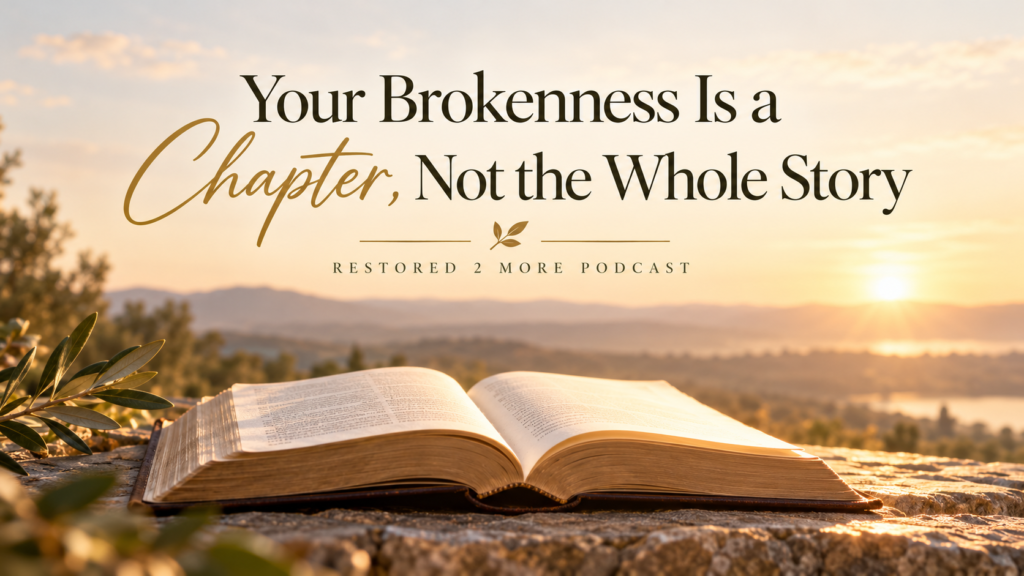
Your Brokenness Is a Chapter, Not the Whole Story
What if God has more for your story than simply recovering from what broke you?
When you’ve walked through addiction, betrayal, trauma, or deep relational wounds, it’s easy to let those experiences become part of your identity.
You begin to see yourself through the lens of what you’ve done, what’s been done to you, or what you’ve spent years trying to overcome.
You become the addict. The betrayed spouse. The unfaithful spouse. The broken one. The one who is still trying to put the pieces back together.
And while those experiences may be a very real part of your story, they were never meant to become your entire identity.
We believe God has so much more for you than simply surviving your past.
In fact, that’s the very heart behind why we named our ministry Restored 2 More.
Are You Willing to Get Up From the Gate?
Recently, we were reminded of a beautiful story in Acts 3 that captures so much of what we believe about healing and restoration.
In this passage, we meet a man who had been unable to walk since birth. Every day, someone carried him to the Beautiful Gate outside the temple, where he would sit and beg for money.
This was his reality. Day after day, year after year, he sat at the same gate, dependent on others and hoping someone would give him enough to get through another day.
But one day, everything changed.
Peter and John were walking into the temple when the man asked them for money. Peter looked at him and said:
“I have no silver and gold, but what I do have I give to you. In the name of Jesus Christ of Nazareth, rise up and walk.” — Acts 3:6
And immediately, the man’s feet and ankles became strong.
But what happens next is what moved us the most.
He didn’t just stand up.
He didn’t just take a few steps.
He went walking, leaping, and praising God!
Can you imagine?
The man who had spent his life sitting outside the temple was now entering it with joy, celebrating what God had done in his life.
And here’s what we find so beautiful about this story:
He didn’t go back to the gate.
He wasn’t defined by the years he spent begging. He wasn’t living as though he were still unable to walk.
His past was still part of his testimony, but it was no longer the reality he was living in.
And we wonder how many of us, after experiencing healing, are still sitting at the gates of our past.
Three Questions We Believe Can Change Your Recovery Journey
As we reflected on this passage, three questions came to mind. Questions that we believe are worth asking, whether you’re just beginning your healing journey or you’ve been in recovery for years.
1. Do You Believe God Can Heal You?
When you’re in the middle of betrayal, addiction, or trauma, healing can feel impossible.
We remember those early days of our own recovery. There was so much pain, confusion, fear, and uncertainty.
We didn’t know what our marriage would look like on the other side. We didn’t even know if we would make it to the other side together.
And when you’re hurting that deeply, sometimes all you can see is the pain right in front of you.
But we serve a God who restores.
A God who meets us in our brokenness, who sees the places we are hurting, and who invites us to bring those places to Him.
We had to begin believing that the God we read about in Scripture was the same God who could meet us in our story.
Not that the journey would be easy. Not that healing would happen overnight. But that our brokenness wasn’t beyond His redemptive power.
2. Do You Actually Want to Be Healed?
This might sound like a strange question.
Of course we want healing, right?
But in John 5, Jesus approaches a man who had been unable to walk for 38 years and asks him a similar question:
“Would you like to get well?” — John 5:6
It’s a question that requires us to look a little deeper.
Because sometimes we want relief from our pain without being willing to walk through the process of healing.
We want our marriage to feel better, but we’re afraid of the difficult conversations.
We want freedom from addiction, but we’re hesitant to surrender the habits, secrecy, or comforts we’ve depended on.
We want to rebuild trust, but we’re afraid of the vulnerability and accountability that requires.
Clint remembers how many excuses he had in the early days of recovery.
He wanted freedom, but he also knew that pursuing it would require sacrifice, honesty, and surrender.
And we understand that feeling.
Healing can be frightening. Sometimes the very things that could help us move forward are the things we’re most afraid to face.
But there comes a moment when we have to ask ourselves:
Am I willing to surrender what is keeping me stuck so I can experience what God has for me?
And for those who have experienced betrayal or trauma, we want you to hear this too: healing isn’t something you have to force, rush, or perform. Your pain matters. Your safety matters. And there is grace for the process.
3. When Healing Comes, Are You Living in Your New Identity or Being Shamed Into Your Old One?
This is the question that has been especially meaningful to us lately.
Because sometimes we can experience real growth and transformation, yet continue to identify ourselves by our darkest chapters.
We continue calling ourselves by the names of our past.
We continue believing that our brokenness is the most important thing about us.
And sometimes shame convinces us that we don’t deserve to live any differently.
But Scripture tells a different story.
“But you are a chosen race, a royal priesthood, a holy nation, a people for his own possession…” — 1 Peter 2:9
You are chosen.
You are loved.
You are forgiven.
You are a child of God.
Your identity is not found in what happened to you or even in the worst things you’ve done.
For us, this has been such an important part of our journey.
Clint can acknowledge that he was unfaithful. That pornography and sexual addiction were part of his story. That his choices caused tremendous pain.
Those are important truths, and taking responsibility for them matters.
But those choices don’t have to define the man he is today.
And Charity’s experience of betrayal will always be part of her story, but being betrayed is not the entirety of who she is.
We are not denying our past. We are refusing to let our past determine our identity and future.
God Doesn’t Just Heal Us From Something. He Restores Us to Something.
One of our favorite passages, and the verse that helped inspire the name Restored 2 More, is 1 Peter 5:10:
“And after you have suffered a little while, the God of all grace, who has called you to his eternal glory in Christ, will himself restore, confirm, strengthen, and establish you.”
We love that this verse doesn’t end with restoration.
It continues.
Restore. Confirm. Strengthen. Establish.
There is more!
When we first began walking through our marriage restoration, our greatest hope was simply that we could somehow put our marriage back together.
That we could rebuild trust.
That we could feel safe again.
That we could experience friendship, intimacy, and love without our past constantly standing between us.
And those things were incredibly important.
But as God began working in our lives, we started to realize that He wasn’t simply calling us back to the marriage we had before.
He was inviting us into something new.
A marriage rooted in greater honesty, vulnerability, friendship, intimacy, faith, and purpose.
And eventually, He began using the very story that had once brought us so much shame and pain to bring hope to other people.
We never could have imagined that in our darkest moments.
But that’s the beauty of redemption.
God can take the places of our deepest pain and turn them into places where others encounter hope.
What If Recovery Is a Chapter, Not the Destination?
We are incredibly grateful for recovery programs, groups, counselors, mentors, and communities that help people heal.
Those resources have played an important role in our journey, and we believe there is tremendous value in having safe people who will walk alongside you.
But we also believe that recovery was never meant to be the fullness of your identity.
There is a difference between continuing to receive support and believing that you will always be defined by your wounds.
Some healing journeys take years. Some require ongoing support. And that doesn’t mean a person has failed to experience transformation.
But we hope that, somewhere along the journey, you begin to see more than the pain.
That you begin to experience joy again.
That laughter returns to your home.
That friendship grows in your marriage.
That you discover new dreams, passions, and opportunities to serve.
That instead of only asking, “How do I keep from going backward?” you begin asking, “God, what are You inviting me into next?”
Because there is so much more to life than trying not to fall apart.
You were created for more than survival. You were created for relationship, joy, love, purpose, and a life that reflects the goodness of God.
Your Marriage Can Become a Testimony of God’s Grace
One of the things we love most about the story in Acts 3 is what happened after the man was healed.
People noticed.
They recognized him as the man who had been sitting outside the gate, and they were filled with wonder and amazement.
His transformed life pointed people toward God.
And we believe our marriages can do the same thing.
You don’t have to start a ministry.
You don’t have to write a book.
You don’t have to stand on a stage or share every painful detail of your story with the world.
Sometimes your testimony looks like standing together at your child’s soccer game, holding hands and laughing.
Sometimes it looks like choosing kindness during a disagreement.
Sometimes it’s sitting across from another couple and telling them, “We’ve been through some really hard things too, but there is hope.”
Sometimes it’s simply allowing people to witness a marriage marked by love, safety, forgiveness, and joy.
People may never know every chapter of your story.
But they can still see the fruit of what God is doing in your life.
And perhaps one day, someone will ask you what makes your marriage different.
And you’ll have the opportunity to say:
Let us tell you what God has done.
God Isn’t Finished Writing Your Story
We often think about our lives like a book.
There are chapters filled with joy and adventure, and there are chapters we wish we never had to live through.
For us, addiction and betrayal were some of the most painful chapters of our marriage.
We wouldn’t wish that pain on anyone.
And yet, those chapters are not the end of our story.
There’s so much more to us than what happened.
We are still learning. Still growing. Still discovering new places where God wants to shape our hearts and use our lives.
And we believe the same is true for you.
Maybe you’re in chapter one or two of your healing journey, and everything still feels uncertain.
Maybe you’ve spent years doing the hard work of recovery, and you’re beginning to wonder what comes next.
Maybe you’ve made tremendous progress, but shame keeps pulling you back toward the person you used to be.
Wherever you find yourself, we want to encourage you:
Don’t let your hardest chapters convince you that the rest of your story has already been written.
There is still more joy to experience.
More love to give.
More friendship to build.
More purpose to discover.
More people to encourage.
And more of God’s goodness to encounter.
The man at the Beautiful Gate didn’t spend the rest of his story sitting where he had always been.
He got up.
He walked.
He leaped.
And he praised God.
Our prayer is that we would become people who live with that same kind of joy and gratitude—not because our past never happened, but because our past no longer has to define our future.
Your brokenness is a chapter, not the whole story.
And God isn’t finished writing yours.